Mindfulness as a Stepping Stone

Mindfulness can be an effective tool and serves as a stepping stone towards attaining enhanced self-awareness and inner peace. It promotes conscious awareness of your thoughts, emotions, and physical sensations “in the present moment” while fostering an accepting and non-judgmental attitude towards yourself and others.

However, mindfulness alone is not enough to bring about lasting transformation. To achieve enduring change, it is crucial to cultivate wisdom, compassion, and other affirmative qualities. This necessitates a committed and continuous endeavour to train the mind through practices like meditation, self-reflection, and improved awareness.

Ultimately, the goal is to develop a deep understanding of yourself and the world around you and to cultivate a sense of inner peace and well-being that is not dependent on external circumstances. This is a lifelong journey that requires patience, perseverance, and a willingness to embrace change and growth.

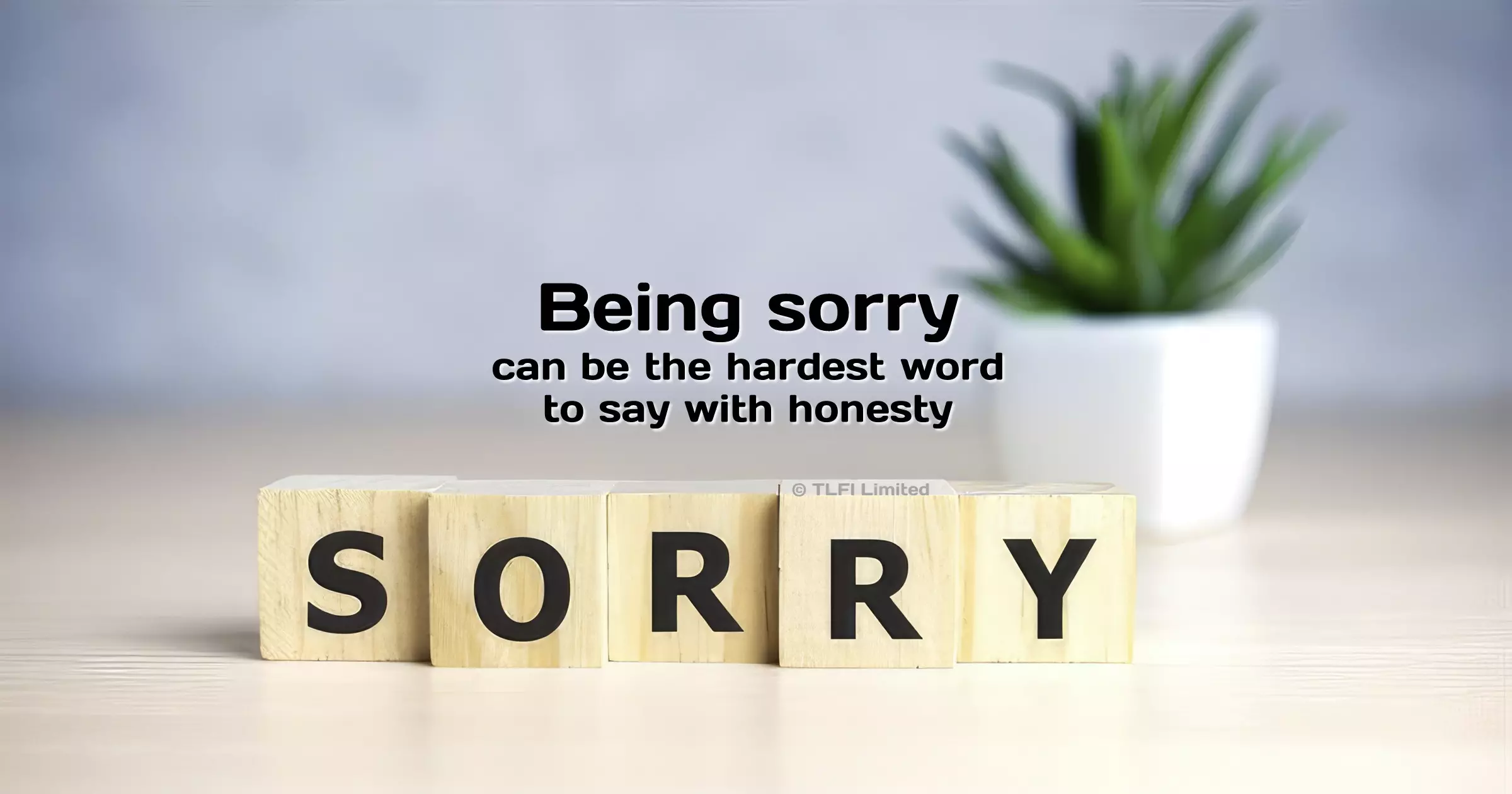
Sorry can be the Hardest Word

Do not be afraid to be the one to say sorry after an argument or disagreement, even if you think you are in the right. Being sorry is not about taking a proverbial side, winning or losing. It is an exploration into the realm of friendships and relationships which underscores the transformative power of humility, gratitude, and the acceptance that compromise should be seen as a cornerstone of harmonious connections.

In the heat of disagreements, the ego often stands tall, fuelling the belief that admitting fault or offering an apology is a sign of weakness. However, the opposite holds true. Apologising requires a deep well of strength and self-awareness, an acknowledgement that relationships are nuanced, and the pursuit of being right at the expense of connection is a hollow victory. Learning to say sorry becomes a bridge that spans the chasm created by disagreements, fostering understanding, and fortifying the foundation of trust.

The essence of compromise is a hard lesson to grasp, especially in a world that increasingly fosters individuality and the pursuit of personal desires. Yet, as you navigate the complex web of relationships, both personal and professional, hopefully, you may realise that compromise is not a surrender or loss. It is an acknowledgement that more often than not, we need to work together in life to achieve mutual understanding and shared happiness.

Gratitude becomes the natural offspring of the willingness to apologise and compromise. When you embrace the humility required to say sorry, it can help you to better appreciate the friendships and relationships around you. Gratitude allows you to shift the focus from what is lacking or perceived to be lost, to what is present or achieved. In the act of saying sorry, you can not only mend interpersonal bridges, but also cultivate a grateful heart that sees the richness of what already exists.

Realise that simply saying sorry can make such a difference, whether it is to defuse a situation or to make things right. So take the time to contemplate that being sorry is not so difficult to achieve.

Escaping Emotional Jail

Emotional Jail is a powerful metaphor that encapsulates an entrapment which you may experience, due to the web of self-limiting thoughts and emotions manifesting when you get into a so-called emotional state. When you get deeply emotional, it becomes hard to recognise the barriers built by the passive intellect of the mind. In the throes of an emotional state, the passive intellect orchestrates a relentless parade of self-limiting thoughts and corresponding emotions, constructing an intricate tapestry of limitations and excuses. These thought patterns become the bars of your emotional jail, restricting your ability to think clearly. This metaphorical emotional prison is not only a construct of your mind, but also an energetic state that takes its toll on your mental, physical, and emotional well-being.

Escaping your emotional jail is about how you can learn transformative techniques to break the chain of emotional cause and effect. Thereby giving you an opportunity to break free from this emotional quagmire of your own construction.

The journey to escape the emotional jail is an inner odyssey, requiring commitment to mindful awareness and bringing forward cognitive mastery. As you cultivate these skills, they can help you to become aware of the thoughts and emotions which have formed the prison bars and walls. Being aware is the first step to being able to dismantle the walls of self-imposed limitations, creating an opening for renewed mental and emotional freedom. Escaping your emotional jail, requires reclaiming control over your thoughts and emotions, unlocking the potential for a more liberated, empowered, and balanced existence.

Entering into a state of cognition is an extremely useful key to unlocking your emotional jail. This is not a passive quietening of your mind, but a deliberate and focused effort to silence the cacophony of the thoughts. Cognition involves a dedicated purpose of thought, a specific conscious redirection of mental energy toward constructive, empowering, and liberating perspectives. By quietening the mind with intention, you can create a space for clarity, and the dissolution of the emotional jail’s energetic grip.

How Negative Thoughts Affect You

Delving into the intricacies of the human psyche, it becomes evident that negative thoughts or thinking have an impact which extends beyond thoughts themselves. To better comprehend the impact of your thinking, you need to consider the profound connection between your thought patterns, emotions, and the energetic fabric of your being. This may lead you to the realisation that your mind is not only a generator of thoughts, but a sculptor of the energetic landscape that shapes our overall well-being.

Negative thoughts act like dense clouds, casting deep and long shadows over the mental landscape. If your mind fixates on these destructive aspects, it unwittingly fuels their energetic existence. The energy generated by persistent fear, worry, and destructive emotions can coalesce into a formidable barrier; an energetic interference, akin to static, disrupting the natural flow of the human mechanism.

This energetic disturbance, when left unchecked, becomes a major contributor to both physical ailments and mental imbalances; echoing the profound connection between the mind and the body.

Understanding the energetic consequences of negative thoughts becomes a pivotal point in the pursuit of your well-being. The realisation that your mental states are interlinked with the physical and energetic dimensions of your being can inspire a shift in perspective. By cultivating this awareness, you can redirect the energy of destructive thoughts, or transform their nature through methodologies such as emotional alchemy.

This basic understanding of how negative thoughts can affect you, gives the insight to break the cycle of negative thought patterns, promoting mental clarity and emotional resilience.

Your World in Your Mind

The perception of the world around you is greatly influenced by the state of your mind as you experience the world through your mind. These perceptions are not mere reflections of the outside world, but are powerful filters on life. The lens through which you view the world is shaped by the state of your own consciousness.

This symbiotic relationship between internal states and external experiences highlights the pivotal role of perception in shaping our interpretation of reality. This important fact acknowledges that your inner landscape, teeming with thoughts, emotions, and feelings acts as the master painter, imparting hues and tones to the canvas of your reality.

Once you become more aware that your mind colours your perceptions of the world around you, you can begin to appreciate how these perceptions can be altered. If your mind is clouded with negative or despondent thoughts, the world may be manifest in a gloomy hue. Conversely, when your mind is filled with happiness, the world will take on a similar positive outlook.

By understanding the profound impact your mind can have in your life, you can take the opportunity to alter or recolour your perceptions. You are capable of changing the ordinary into the extraordinary and shaping a world that resonates with the vibrancy of your innermost thoughts and emotions.

Learning Through Life’s Experiences

Life can often teach us all valuable lessons through our experiences, and often more significantly through what we would term mistakes. When you make mistakes, it is imperative not to berate yourself. Instead look at this as an opportunity to reflect on what proverbially went wrong, then learn from your experiences. Even better yet, apply this learning to make changes to your thinking, behaviour or decisions going forward.

Making mistakes or odd slip-ups is a natural part of the learning process and can help us to develop resilience, perseverance, and a greater sense of self-awareness. When you have made a mistake, you should take the opportunity to honestly look at what happened, rather than trying to blame someone else or the situation. In doing so, you force yourself to examine your weaknesses and limitations which leads to the problem. That is the source of learning which can then be applied forward in your life.

It’s important to bear in mind that learning from your mistakes, blunders, missteps or even faux pas calls for readiness, to be honest with yourselves, take responsibility for your actions, and make a real effort to learn from your experiences. It is additionally important to exercise self-compassion and forgiveness. You do not want to proverbially beat yourself up about a past blunder or error which after all is now in the past and cannot be changed. Try to limit the time you spend examining the past, because if you dwell too long on these past incidents you may find yourself being dragged back down to the level of the problem and situation, which could be damaging to your overall mental well-being.

Take the opportunity to examine and learn from your mistakes. You do not need to live them over and over again in your mind. Then accept and embrace the learnings which have been gained from the past, to provide an effective means to grow and develop as an individual.

Your Astrological Key Codes

Your astrological key code is encoded within you at the time of your birth due to the ambient solar system energies. This astrological key code is similar to the programming within an app on your smartphone or computer program. It helps to define your standard pre-programmed ways of thinking and reactions to life.

At the time of your birth, the energies of the constellation behind the Sun (your Sun sign) will be amplified to create astrological programming within you. This precast programming contains a blueprint of the emotional reactions you will have, the type of thought patterns you resonate with, as well as the strengths and weaknesses of your body. The personality traits and aspects of your birth constellation will form an underlying basis for how you think and the flow of emotions in your life. It is because of this astrological key code, that you will react more strongly to different people and situations in your life.

When the ambient energies of the Solar System or constellations resonate more strongly with your astrological key code, then it is likely you will react or respond with greater intensity. So now, you may begin to appreciate how different people can absorb, process and respond to the same situations in life in completely different ways, as their astrological key code colours their life and reactions.

Once you realise how you react and express thoughts and emotions is pre-programmed, you can more easily adapt to situations in life.

Discover How to Observe Your Thoughts

Many of us are not aware of how active our minds are throughout the day generating a huge number of thoughts. If you stop for a moment, as you try to quieten your mind, you may soon discover the myriad of thoughts which abound within your mind. It is not uncommon that the harder you try to find a proverbial quiet corner, the more thoughts you are likely to discover. This clearly proves that your mind is forever busy often generating thoughts which do not fully register in your consciousness. The challenge is that with so many thoughts rampaging through your mental mind and subconscious mind, is that you could be reacting to thoughts without even realising they were present in the first place.

We can all do ourselves a proverbial favour by spending some time learning to listen to or observe the thoughts which flow through our minds, whether they be conscious or subconscious thoughts. As you become more skilful at listening or observing your thoughts, you can begin to identify any critical, malicious or negative thoughts or ideas before they take hold within you. Catching such thoughts early on means that you can more easily change them to something of a more positive nature.

There are many different methods you can utilise to observe your thoughts, from the use of simple mindfulness, through various forms of meditation, to advanced studies in Cognition. The key to all of these methods to be successful is that you should observe your thinking as if you were looking from the outside. The best analogy is that as the observer of your mind, consider that you are witnessing a film or a play unfolding. As you witness these thoughts, do your best to remain the observer. Do not allow your emotions to drag you into the narrative, otherwise, you will start living out the thoughts rather than being the observer.