Taking a Different Path

If the world seems to be telling you that you took a wrong turn, try to admit it honestly and put yourself on a different track. Sometimes we head off down the wrong path in life, often with the best motives. Maybe there was no way of knowing that it was the wrong

path until you embarked upon the journey. No one can be brilliant at everything, and sometimes you must try things to find out whether it feels right and compatible for you.

There is no shame in admitting it once you realise that things are not working out. It is not about quitting, but taking the courage to then look at different directions in your life.

The Stop Scrolling Challenge

Take up the challenge to stop scrolling through things on your smartphone for a minute after reading this. With the ever increasing use of modern technology, it is becoming increasingly common to find people of all ages continually being on their smartphones, immersed in VR or playing games.

So, take the one minute stop scrolling challenge now.

Turn down the volume of your smartphone, turn off the screen and put it away.

Use the time to focus your mind on the growing silence which fills the growing void or the seeming gap in time which has opened up.

As you breathe, allow the increasing sense of quietness to pervade every corner of your mind. If other thoughts start to encroach on the quietness, strive to push them aside, giving your mind one true minute of focus and calmness.

Do not be afraid of the quietness or silence, notifications, DMs and other interruptions can wait. Your ability to maintain the focus of your mind is a sign of your inner strength.

Build upon this challenge and do it at least once per day, you will be surprised how much of a difference this simple stop scrolling challenge can make you feel. If you have succeeded in the one minute challenge, try pushing yourself for a greater experience by reaching for a quiet time of 5 or more minutes.

Everyday Happiness

Life is predominantly composed of ordinary moments, far outnumbering the extraordinary ones. Whether you are patiently queuing at the supermarket, enduring the daily commute to work, or tending to routine tasks such as feeding pets or doing the washing, the ordinary hours make up the fabric of your existence.

The essence of true happiness lies in the ability to discover moments of joy and fulfilment within the seemingly mundane routines of daily life. Real happiness is about finding beauty in the simplicity of everyday life, appreciating the small pleasures that weave through the tapestry of ordinary hours.

It can be as simple as witnessing the magic of how sunlight bounces off the corner of a sugar crystal left on the side of your coffee cup in the morning. Then through being open to the experience you have noticed how the sunlight reflected through that sugar crystal is scattered in a rainbow of colours onto an otherwise plain wall. Then recognise that happiness, joy, wonder or contentment can flourish in the most unassuming moments.

Mindfulness is Not Always the Answer

Mindfulness is a helpful practice that can contribute to overall happiness, but it may not always be the answer you need or are looking for. Mindfulness, the hugely popular zeitgeist theory seems to have morphed into the concept that to be happy we must live fully in the present moment. Taken to the extreme this can lead to total focus on whatever you are doing or experiencing “Right This Second”. Some see Mindfulness as a revolution. It is sweeping through many aspects of people’s lives, from mindful parenting, mindful business dealings, mindful eating, and even mindful chores to mindful walking, promising all types of revolutionary changes in people’s lives.

Happiness is a complex and multifaceted concept that is influenced by many factors. While mindfulness can be a helpful tool for cultivating happiness, it is not a standalone solution to all of life’s challenges and is actually beneficial for many other reasons. Other factors in life should be an important source of joy and happiness. So, while mindfulness can be a useful practice for cultivating happiness, it is not a panacea or a one-size-fits-all solution for everyone.

Mindfulness simply involves focusing your attention on your thoughts, feelings, and physical sensations as they arise in the present moment. Mindfulness does not magically create happiness or a better life, it is just a tool which can be used for intentionally paying attention to the present moment and not just with focus, but also with curiosity, openness, and non-judgment. It is often the later aspects which are overlooked in the rush to embrace mindfulness, or follow the latest mindfulness guru or influencer. Mindfulness should be taken as one aspect of many meditative practices which can be used for focus and the reality is that some people do really have problems with the proverbial “Raisin of Mindfulness”. It is important to explore a range of different practices and techniques to find one that works for you to cultivate lasting happiness and improve your mental well-being.

Remember that while Mindfulness is a great tool, it is like a hammer, you cannot do every job with a hammer, and sometimes you need to use a different tool.

Why Should I Witness my Thoughts?

Witnessing your thoughts can be advantageous in numerous ways. To start with, it can assist you to understand your own thinking patterns, propensities and even your reactions. Likewise, it aids you to become more self-aware, to enhance your emotional intelligence and ability to relate to others. Furthermore, by listening within to your thoughts, you can come to be more mindful of your internal dialogue and how it might be affecting your behaviours, mood, and emotions. If that were not sufficient, then listening to your thoughts can be an effective tool for self-reflection and acquiring insight into your own values, beliefs, and motivations.

One of the most effective methods to listen to your thoughts is as if you were observing them as an onlooker. Acting as that onlooker to your thoughts, you can more effectively be witness to your thoughts as they surface within your mind, aiding you to establish improved self-awareness and control over your thinking patterns. When you observe your thoughts in this way, you have the opportunity to notice patterns of negative or unhelpful thinking, such as worry, concern, overthinking or even self-criticism. By becoming aware of these patterns of thinking, you can start to challenge them when they appear, as opposed to reacting at a later stage to the fully developed thought-form.

Witnessing your thoughts as an onlooker has tremendous potential, because you can develop a sense of detachment from them. You can progressively learn to recognise that you can more easily change your thoughts when you are an observer of your mind. This can help you to let go of unhelpful thoughts and emotions, and cultivate a sense of clarity and inner tranquillity. Ultimately listening to your thoughts in this way can help you to live a more mindfully and purposefully existence, and to develop a more positive and fulfilling life for yourself.

Learning Through Life’s Experiences

Life can often teach us all valuable lessons through our experiences, and often more significantly through what we would term mistakes. When you make mistakes, it is imperative not to berate yourself. Instead look at this as an opportunity to reflect on what proverbially went wrong, then learn from your experiences. Even better yet, apply this learning to make changes to your thinking, behaviour or decisions going forward.

Making mistakes or odd slip-ups is a natural part of the learning process and can help us to develop resilience, perseverance, and a greater sense of self-awareness. When you have made a mistake, you should take the opportunity to honestly look at what happened, rather than trying to blame someone else or the situation. In doing so, you force yourself to examine your weaknesses and limitations which leads to the problem. That is the source of learning which can then be applied forward in your life.

It’s important to bear in mind that learning from your mistakes, blunders, missteps or even faux pas calls for readiness, to be honest with yourselves, take responsibility for your actions, and make a real effort to learn from your experiences. It is additionally important to exercise self-compassion and forgiveness. You do not want to proverbially beat yourself up about a past blunder or error which after all is now in the past and cannot be changed. Try to limit the time you spend examining the past, because if you dwell too long on these past incidents you may find yourself being dragged back down to the level of the problem and situation, which could be damaging to your overall mental well-being.

Take the opportunity to examine and learn from your mistakes. You do not need to live them over and over again in your mind. Then accept and embrace the learnings which have been gained from the past, to provide an effective means to grow and develop as an individual.

Your Astrological Key Codes

Your astrological key code is encoded within you at the time of your birth due to the ambient solar system energies. This astrological key code is similar to the programming within an app on your smartphone or computer program. It helps to define your standard pre-programmed ways of thinking and reactions to life.

At the time of your birth, the energies of the constellation behind the Sun (your Sun sign) will be amplified to create astrological programming within you. This precast programming contains a blueprint of the emotional reactions you will have, the type of thought patterns you resonate with, as well as the strengths and weaknesses of your body. The personality traits and aspects of your birth constellation will form an underlying basis for how you think and the flow of emotions in your life. It is because of this astrological key code, that you will react more strongly to different people and situations in your life.

When the ambient energies of the Solar System or constellations resonate more strongly with your astrological key code, then it is likely you will react or respond with greater intensity. So now, you may begin to appreciate how different people can absorb, process and respond to the same situations in life in completely different ways, as their astrological key code colours their life and reactions.

Once you realise how you react and express thoughts and emotions is pre-programmed, you can more easily adapt to situations in life.

Discover How to Observe Your Thoughts

Many of us are not aware of how active our minds are throughout the day generating a huge number of thoughts. If you stop for a moment, as you try to quieten your mind, you may soon discover the myriad of thoughts which abound within your mind. It is not uncommon that the harder you try to find a proverbial quiet corner, the more thoughts you are likely to discover. This clearly proves that your mind is forever busy often generating thoughts which do not fully register in your consciousness. The challenge is that with so many thoughts rampaging through your mental mind and subconscious mind, is that you could be reacting to thoughts without even realising they were present in the first place.

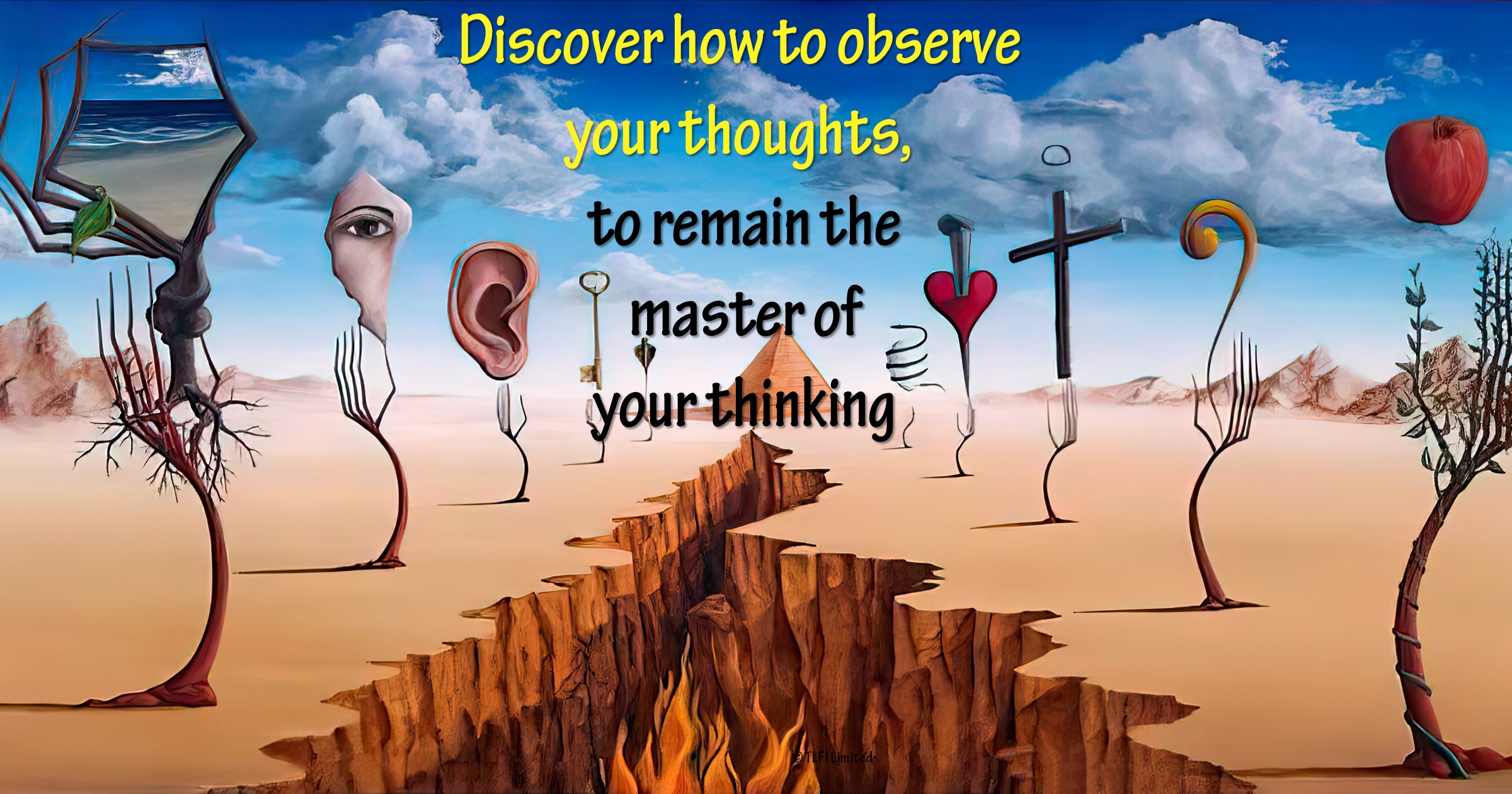
We can all do ourselves a proverbial favour by spending some time learning to listen to or observe the thoughts which flow through our minds, whether they be conscious or subconscious thoughts. As you become more skilful at listening or observing your thoughts, you can begin to identify any critical, malicious or negative thoughts or ideas before they take hold within you. Catching such thoughts early on means that you can more easily change them to something of a more positive nature.

There are many different methods you can utilise to observe your thoughts, from the use of simple mindfulness, through various forms of meditation, to advanced studies in Cognition. The key to all of these methods to be successful is that you should observe your thinking as if you were looking from the outside. The best analogy is that as the observer of your mind, consider that you are witnessing a film or a play unfolding. As you witness these thoughts, do your best to remain the observer. Do not allow your emotions to drag you into the narrative, otherwise, you will start living out the thoughts rather than being the observer.