When Should I Meditate

A usual query which people ask is when should I meditate? While there may be various schools of thought on the topic, there is no golden rule as to when to practice meditation as it can be unique to each one of us as individuals. However, many meditation instructors do concur that the most important aspect is to create some time for you, regardless of the time of day or any kind of timetable.

While formal meditation practice in a peaceful location where you are less likely to be interrupted is optimal, there need be no reason why you cannot employ aspects of mindfulness and meditation at any other time in your life. Without a doubt, it can frequently be in these hectic or stressful moments when you require the benefits of your mindfulness or meditation practices the most.

There are lots of times all throughout the day when you can apply your attention to help bring elements of calmness within you. When you travel on a train or bus, you can bring your attention to your breath. As you stroll down the street or take a walk through the park, you could focus on the sounds you hear or the motion of your legs. These practical and straightforward aspects of mindfulness should be incorporated into your daily life, so that mindfulness is not something separate, but is part of living.

In a similar way undertaking full meditation activities must not be treated like a chore which is slotted into an established timeslot each week. While carrying out meditation at a particular time of day can be beneficial, the reason is that doing your meditations at an established time builds a sense of commitment and focus within your meditation practice. Some people discover that it is best to do their meditation in the morning, yet if you are proverbially not a morning person then forcing yourself to do a morning meditation can be counterproductive. Others find it is best to do meditation in the evening to help them unwind and destress from the day. You may find that practising meditation after eating can be less effective, as your physical body is more focused on digesting your food. However, some people have actually discovered that after eating, their body is focused on food digestion, so their minds can be more focused on meditation.

The takeaway from all of this is that meditation can be done at any time. Find a time which works for you, and make use of that time routinely when you are starting to meditate. Once you have become familiar with your meditation techniques and it has become integrated into your life, then there is absolutely no reason why you cannot do meditation at any time throughout the day or night. Ultimately the most important thing is that you invest the time to do meditation on a regular basis to ensure that it becomes a natural part of your life.

Most of the aspects of Breathe with Purpose and Life Force Mindfulness have been developed to make sure that they can be applied at any time. The key is that via practice and repetition, you program the activities into your mind so that they can be conveniently recalled and applied when they are needed.

Anchor Your Reactions

When you find yourself in the middle of a negative or unproductive reaction, perhaps you may have noticed how your breathing often becomes superficial and more rapid, and you may well feel unsettled in the stomach area, or a pulsing in your head. Sometimes your face might become flushed, or your chest area could start to tighten up as your emotions seem to start running out of control. After that, it can become like a slippery slope as thoughts can arise and emerge, which seem to make the matter even worse, and your emotions seem to go into overdrive.

There are many different techniques which can be leveraged to help you stop sliding deeper into this reactionary process. Simple breathing with conscious intent, can be a very effective means to stop this slide, anchoring your thoughts to one point. With yourself anchored, you have the opportunity to pause and choose to stop the continued reactionary process. The next time when you experience an adverse reaction to anything in life, do your utmost to apply some conscious breathing. By engaging your mind to bring focus to your breathing for a couple of moments, you can start to regulate your reactions. Then as you begin to take deeper and more rhythmical breaths, they can help you to find an anchor for your calmness. Allow this anchor to grab hold, and steady your emotions as you continue to breathe consciously.

Making Astrology and Science Work

For many years those that believed in astrology were seemingly at odds with those who trusted in the sciences. This is predominately because the observable locations of the Sun, Moon and planets relative to the constellations do not match with the star signs of astrology. While some kinds of astrology such as sidereal astrology are closer to the real positions, there are still significant differences. It had seemed inconceivable for someone to believe in both astrology and the sciences until now, however that all changes with the new paradigm of Astronomical Astrology.

The foundation of Astronomical Astrology is the actual observable locations of the Sun, Moon or planets relative to the eighteen constellations of the extended zodiac which fully aligns with the science of Astronomy. An extended Zodiac is necessary because the orbits of the Moon and the planets are not in the same plane as that of the Earth. Consequently several of these celestial objects can be observed either above or below the ecliptic (the path of the Sun’s motion traced across the celestial sphere throughout a year due to the Earth’s orbit).

The mechanics of the motion of the planets, together with our frame of reference, are explained in considerably more detail at Astronomical Astrology. The greatest cause for the big difference between the astrological constellations to what is observable, is due to a phenomenon labelled the “Precession of the Equinoxes”. This precession of the equinoxes moves slowly westwards across the sky over a cycle of 25,772 years, creating a drift in the observed position of the astronomical constellations. What this means is that each astrological star sign typically will include the astronomical constellation that was formerly to the east. There is a further complication by the fact that the constellations are not twelve equal 30-degree sectors of the ecliptic. Further adding to this complexity, each of the heavenly bodies transverses each constellation at a perceived angle and a different elevation. Once all of these variables are collated, the full picture of Astronomical Astrology emerges as the predicted location of any celestial body aligns precisely with the astronomically observable facts.

This new type of Astrology might be hard to believe for some people, as they have connected with being a particular star sign for most of their life. Importantly Astronomical Astrology does not disregard the aspects of what you have believed throughout your life. It has to be realised that thoughts are their own energies, which can form a layer of reality around you. So you may find that you exhibit aspects of the star sign you think you are, due to your thoughts. While at the same time, you will discover that you react subconsciously as a result of the energies which are the real astronomical influences. This is the nature of the reality of our lives, as we are affected not only by aspects of Astronomical Astrology, but just as importantly we are strongly influenced by our thoughts.

Finding True Astrology

Astrology has been steeped in misunderstanding, confusion, dogma and even superstition for many years. Yet it strangely is discussed as being separate from the scientific discipline of astronomy and the actual observation of the sky and stars. With True Astrology, these two seemingly inharmonious areas of knowledge are combined, bringing into view astrology backed by precise and scientific knowledge to yield the indisputable observations of the Sun, Moon and planets throughout the skies. This extraordinary form of astrology takes into consideration the complete motion of the planets and the stars, factoring in the precession of the equinoxes and other real-world phenomena.

The awareness, understanding and comprehension of the energies which continually affect and influence you are pivotal to grasping how you live your life. The energies which are patterned by the Sun, Moon and planets as they transit through the constellations influence you and form the basis of True Astrology .

The Constellation Dimensions

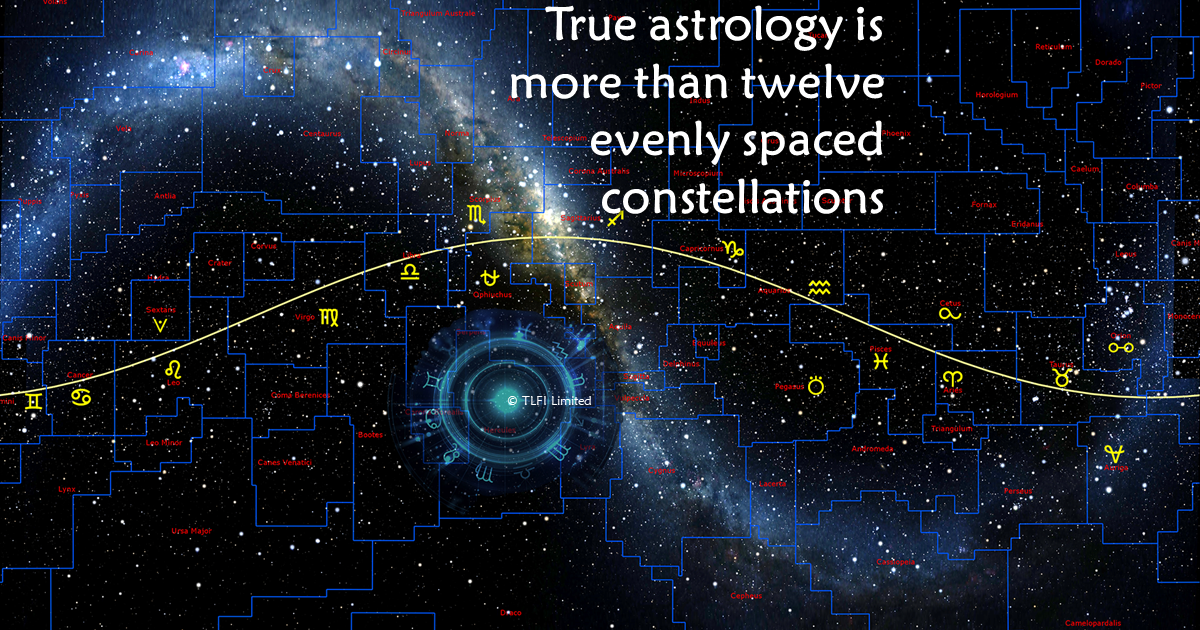
To form a more accurate picture of the energies of life it is necessary to look at the dimensions of the eighteen constellations that the Sun, Moon and planets traverse. The astronomical constellations which are observable in the sky are not divided into the twelve neat and equal segments as typically defined in astrology.

To define the constellation dimensions, Astronomical Astrology uses the constellation boundaries as defined by the International Astronomical Union (IAU) and which is observable in the night sky. The most noticeable difference to other forms of astrology, is that not all constellations are of the same dimension. As an example, the constellation Pisces occupies a much larger space of the sky than the constellation of Cancer. The cosmos add complexity as the inclined path through each constellation results in the Sun, Moon and planets each spending different amounts of time travelling through each astronomical constellation.

Considering these two aspects, each constellation fills varying arcs of the sky. This varies quite significantly from 6.5 days for Scorpio to almost 45 days for Virgo. Tying the constellation dimension complexity into the precession of the equinoxes, means that Astronomical Astrology aligns exactly with the observable universe and science.

What is Precession of the Equinoxes

This phenomenon of the precession of the equinoxes is due to the long term cyclic wobbling in the orientation of Earth’s axis of rotation. This wobble of 1 degree for every 71.6 years was identified by Sir Isaac Newton and has since been better quantified as we have learnt more about the mechanics of the Solar System. We now know that the precession is caused by the gravitational effects of both the Sun and the Moon coupled with the fact that our planet is not a perfect sphere. Consider that the Earth is tilted and that the Sun’s gravitational pull is stronger on the portion that is tilted towards it, thus creating a torque effect on the planet. This torque coupled with the gravitational effects of the moon, which is tilted out of the plane by five degrees, causes the slow but very gradual wobble of the Earth.

The precession of the Earth’s axis has several noticeable effects. The first noticeable effect of this is that the positions of the north and south celestial poles appear to move in circles. The celestial poles take 25,772 years to create a full circle against the backdrop of seemingly fixed stars. Today, the star Polaris lies approximately at the north celestial pole, this will change over time as other stars become the north star. Second, the precession of the equinoxes moves slowly westwards across the sky, causing a drift in the observed position of the astronomical constellations. What this means is that each astrological star sign now contains the constellation that was formerly to the east. As an example, the tropical astrological star sign of Capricorn now covers a sector of the sky which is filled with the astronomical constellation of Sagittarius.

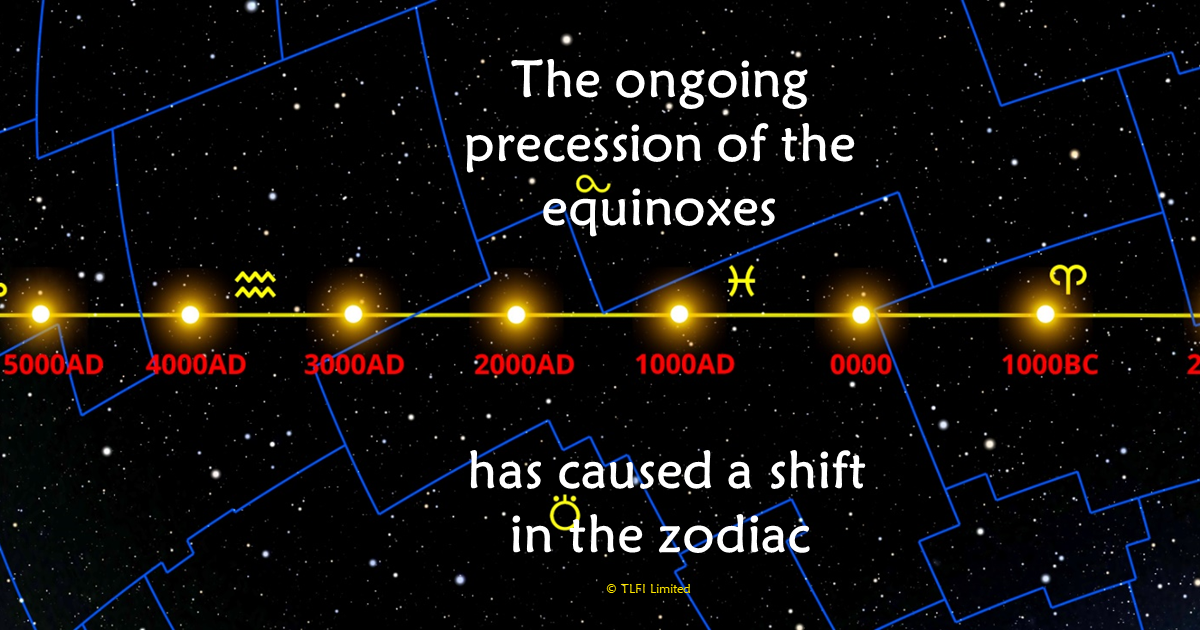
The location of the vernal equinox has shifted approximately 23 degrees westward over the past 2,000 years, will continue to progress westward at approximately 50.3 arc-seconds each year. When the astronomer Ptolemy mapped 48 constellations in the second century, the vernal equinox occurred in the constellation of Aries. Now due to the continued process of precession, the location of this equinox has shifted westward so that the vernal equinox now appears in the constellation of Pisces. This can be proven by simple observation of the night sky or the use of various apps on your smartphone which can map the stars.

The precession of the equinoxes is the prime reason for the difference between the true astronomical positions of the constellations and (western or tropical) astrology. Astronomical Astrology aligns with the science of astronomy and the real observations of the Sun, Moon and planets across the sky by factoring in the precession of the equinoxes.

The illusion of Solidity

Even though the physical form seems solid, science tells us that it is not so, the physical form is largely void. At an anatomical level, our body consists of various systems. These systems are comprised of various cells which perform specific functions necessary for the operation and wellbeing of the entire mechanism. At the microscopic level, the cells are the basic biological and functional unit.

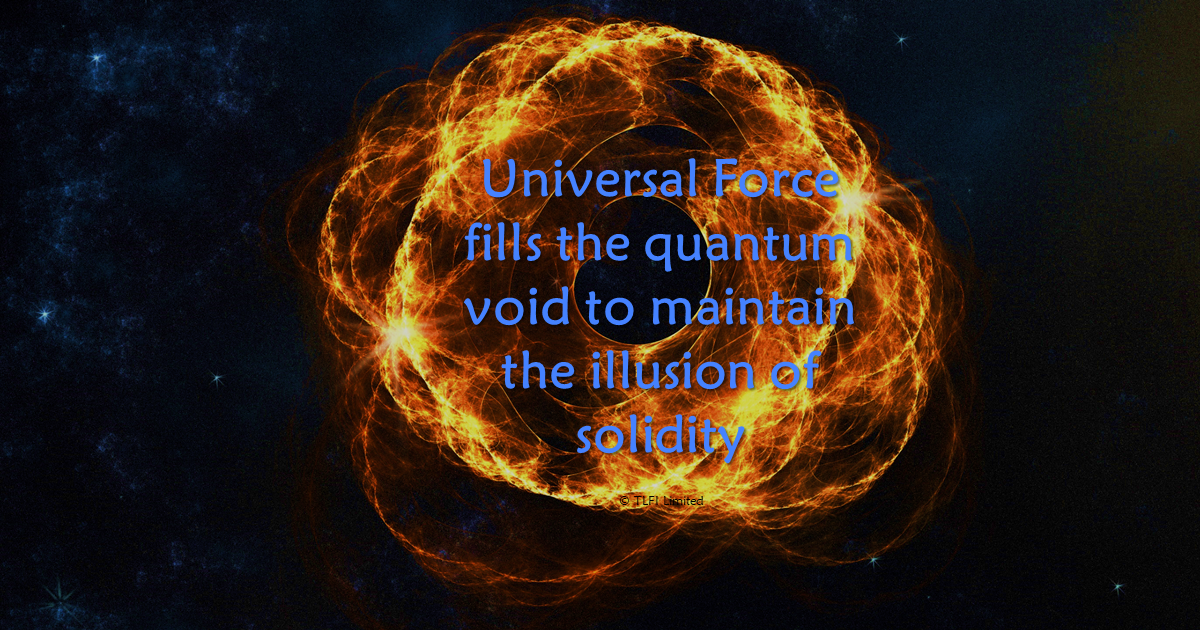
The cells are comprised of smaller components such as proteins, carbohydrates, lipids and other substances. These cellular components are composed of atoms, which are in turn composed of smaller sub-atomic particles. Between and around these sub-atomic components are vast amounts of apparent nothingness. So while we all appear solid, at the sub-atomic level we appear largely empty. However, there is more to this emptiness. This quantum void is infused with the finite aspects of the universal force to maintain the structure of matter and maintain the illusion of solidity.

Precession of the Equinoxes

The major difference between astrology and the observable astronomical constellations is due to the Precession of the Equinoxes. Astronomical Astrology takes into account the rotation, motion and orbits of the earth and planets to build a complete picture of the Galaxy at large.

You may ask, how does an equinox impact the position of the constellations? Equinox means “equal night”, being that time of year when all points on the Earth’s surface experience the same lengths of daylight and darkness. There are two equinoxes each year and the vernal equinox marks the point in time when the Sun crosses the celestial equator and is the beginning of spring in the northern hemisphere.

When Greek astronomer Hipparchus compiled his star catalogue in the year 129BC, he found that the positions of the stars did not match up with the older Babylonian observations. He observed that most of the stars and constellations had shifted a constant amount. This indicated to Hipparchus that it was not the stars themselves that had moved but the frame of reference, Earth, which had changed. Hipparchus concluded that the equinoxes were drifting westward along the ecliptic relative to the stars that were believed to be motionless from the perspective of astronomers, and opposite to the motion of the Sun along the ecliptic. The precession of the equinoxes is an ongoing process that has caused a shift in the position of the zodiac as seen from Earth.