Social Media Slowdown

In the current world, it is easy to get caught up in the hustle and bustle of everyday life; where you are constantly bombarded with information, notifications, and demands on your time, leaving you feeling overwhelmed and disconnected from the present moment. Slow living is a philosophy that offers an antidote to this frenetic pace, encouraging you to slow down, simplify, and savour the richness of your experiences. It is about letting go of the need to be constantly busy. and instead to focus on what is truly important in life.

At its core, slow living is about letting go of the need to be busy and instead embracing a more purposeful approach to life. It is about being aware and present in the moments of life, appreciating the simple things, and savouring the journey rather than rushing to the destination. It is also about making conscious choices about how you spend your time and energy.

One of the most important aspects of slow living is to loosen your grip on your digital devices. In today’s hyper-connected world, phones, tablets, and computers have become constant companions, demanding your attention and being a distraction from the present moment. Being constantly bombarded with information from our phones, computers, and televisions, can sometimes lead to feelings of being overwhelmed or even anxious. By taking steps to spend less time on screens, you can create more space in your life for relaxation, reflection, and connection with others.

To truly embrace slow living, it’s important to create boundaries with our digital devices. There are many ways to create boundaries to reduce your screen time. You can leave your phone at home when you go for a walk or run, allowing you to better appreciate your surroundings through observation. You may also decide to set a digital device curfew for yourself. Plan what time of day you will turn off or silence your device and stick to the plan. Doing so will give you time to wind down and relax, which can be very beneficial before going to bed. Additionally, you can choose to collect all of the social media apps into a folder placed on the last home screen of your device. For some people, this can make it more difficult to mindlessly check social media and will encourage you to be more intentional with the use of your devices.

Slow living is not about rejecting technology or social media, it is about using it in a way that serves you, rather than technology and social media controlling you. It is importantly about being intentional with your time and energy. It is about making conscious choices about what you want to do, and how you want to spend your time. It is about savouring the present moment and appreciating the beauty of the world around you.

In the realm of slow living, the process of disentangling yourself from the frenzy of perpetual activity extends beyond the mere physical realm into a conscious world. It necessitates a shift from the societal conditioning that promotes being busy and engaged.

By releasing the need to constantly move on to the next task, next fad or next reel, slow living becomes a means to achieve a more balanced and fulfilling life. One where the richness of life is not overshadowed by an endless pursuit of more followers or likes in social media as an example, but rather one illuminated by the mindful awareness of each fleeting moment.

Discover the Comma to Pause

Embarking on the journey of life can sometimes feel like attempting to read a book or article without any punctuation; it can seem rushed, chaotic, and lacking the necessary pauses for reflection. Discovering the metaphorical comma draw in life introduces moments of pause and contemplation into our daily lives. Much like a well-placed comma in a sentence, these pauses allow us to take a breath, absorb our experiences, and give careful consideration to the unfolding narrative of our existence.

In this context, the comma draw in life serves as a deliberate choice to embrace moments to increase your awareness and deliberate introspection. In a society that increasingly glorifies constant activity and perpetual motion, the act of pausing as you notionally grab a comma becomes an important act of self-care. You are deliberately recognising the spaces between the hustle and bustle as opportunities, giving that chance for a pause, and fostering a deeper connection with yourself. By intentionally incorporating these commas (moments of stillness and reflection), you can add depth and meaning to the narrative of your life, allowing the richness of experience to settle and resonate, rather than pass by.

The art of the comma to pause, extends beyond personal well-being; it can influence the quality of our interactions and relationships. Just as a well-placed comma clarifies the meaning of a sentence, moments of pause in our interactions can enhance communication, foster understanding, provide time to think and nurture genuine connections. By embracing the metaphorical comma draw, you not only create a space for your thoughts but also open the door for more meaningful and nuanced dialogues with others. In a world that often values speed over everything else, discovering the power of the comma, offers the ability to pause, adding a layer of mindfulness and intentionality to our busy lives.

Strength and Calmness

Self-control is the foundation of strength, while calmness represents the pinnacle of mastery. It is about understanding and harnessing your emotions, not allowing them to dictate your actions and affect your thinking.

True mastery lies in maintaining composure even amidst turmoil, ensuring that your mood remains calm and unshaken by the trivial actions of others. Maintaining composure amidst uncertainty, challenges, or external influences, enables you to safeguard your inner equilibrium and ensure that your decisions are guided by reason rather than fleeting impulses. Do not allow others to control the direction of your life or your emotions, to overpower your active intelligence.

Discovering Mindful Moments

The concept of mindful moments emerges as a simple and effective means to offer a respite from the chaotic rhythm of modern existence. Rooted in Buddhist, meditation and mindfulness principles, these moments aim to cultivate a heightened awareness and presence in your day-to-day experiences. Rather than being swept away by the currents of constant activity, mindful moments invite you to anchor yourself in the present, focusing on the here and now, not lamenting the past or drifting off into the future. There are many opportunities in your life every day to be more observant. The more that you are observant, the more mindful moments you will discover every day.

The essence of mindful moments lies in the intentional redirection of attention to the unfolding present, untethered from the constraints of past regrets or future anxieties. Whether you are savouring the aroma of a morning cup of coffee, feeling the warmth of sunlight on your skin, smelling the fragrance of a nearby flower, or fully immersing in the rhythm of your breath, these moments become portals to a tranquil state of being. The practice encourages you to be observant of your surroundings, thoughts, and emotions without judgment. As you become absorbed in the moment, and truly observant with Ekagrata it may seem as if time slows down. Your perception of time alters as your mind is focused purely in the moment, observing and experiencing what is truly the here and now.

Incorporating this intentional practice into aspects of daily routine can provide you with the necessary respite from the hectic world in which we all seem to live. It can provide you with new insights, and new opportunities for happiness and joy. In this way, mindful moments are not fleeting respites, but rather a way of life, as you experience the fullness of each moment; finding connection in the simplicity of being present.

The Key to Personal Transformation

The exploration of how you think, and the unravelling of your thought patterns, offer you a key to making transformative changes in your life. Your thought patterns are the habitual ways in which your mind processes information and responds to situations. Often these processes and patterns of thinking operate proverbially below the surface, beneath the surface of your consciousness. However, these thought patterns shape your beliefs, behaviours, and overall life experiences. The notional journey of personal transformation involves peeling back the layers of these ingrained thought patterns, shedding light on their origins, and consciously reweaving the fabric of your cognitive landscape.

Unravelling your thought patterns begins with self-awareness and mindful observation of the recurring thoughts that govern your perceptions and actions. Identifying these patterns as they occur without attachment, can allow you to discern whether these mental habits contribute to positive growth and experiences, or hinder, confound or delay aspects in your life. Once recognised, the process of unravelling involves challenging and reframing the limiting or undesirable thought patterns. Once challenged, you can stop any reactionary or subconscious thoughts or actions. You can consciously choose thoughts that align with your aspirations and how you want to become.

The profound impact of unravelling thought patterns lies in its ripple effect across various facets of life. As you learn to be aware of your thoughts and actions, you can begin to dismantle the limiting cognitive processes which may have previously ruled or even ruined your life. This intentional exploration and transformation of your thought patterns act as a catalyst for improved personal development, empowering you to navigate challenges with newfound clarity, cultivate positive relationships, and ultimately shape a life aligned with your authentic self.

Embracing Simplicity in a Complex World with Zen Living

Zen living provides a means for some of us to embrace simplicity amid complexity. Rooted in Zen Buddhism, this approach to life transcends a mere aesthetic preference for minimalism; it is to cultivate mindfulness and intentional living in every aspect of your daily existence. At its core, taking up the principles of Zen living involves stripping away the unnecessary layers of clutter, both physical and mental, to reveal the pure essence of the important aspects of your life. Many have found this a very therapeutic approach to life.

For those of us who have taken this approach to life, embracing simplicity in this complex world is a conscious choice. You choose to prioritise what truly matters, and in the process build a deeper connection with the here and now. One of the hardest aspects is to release attachments to societal expectations and the many associated aspects of material possessions. For those of us who have been able to achieve this, even if in some small way, it allows space for clarity and a heightened awareness of the real richness inherent in each moment. Whether through minimalist home environments, or contemplative meditation, Zen living can provide a means to navigate the complexities of modern life with grace and serenity.

In the modern world, which is characterised by constant noise and distraction, the principles of Zen living offer you a sanctuary of tranquillity. Taking up Zen living is not a proverbial quick fix; it is an ongoing practice that invites you to find joy in the simplicity of existence, fostering a profound appreciation for the beauty that emerges when you take the time to appreciate the moment and what life has to offer.

Take a Deep Breath

Sometimes in life, it can be important to stop to take a breath. Throughout your life, you constantly breathe, but much of this activity is controlled by the autonomic nervous system of the physical body and goes on unnoticed. The act of taking a breath is a conscious decision to step in and control your breathing. This can be extended to observe all sensations around your breath.

So how can consciously taking a breath be so helpful? Well, the first and most important aspect is that it provides a focus for your mind. If you have been having trouble with erratic thoughts or rampant emotions, focusing your mind in this way can be a simple but effective means to create a pause. When you have paused the mind and given it an alternative focus, you have the opportunity to step in and break the pattern of thoughts or emotions which are impacting your life, then make a conscious choice rather than continuing to react with the passive intellect.

You will also find that if you take a deep and purposeful breath, the act of your deep breathing activates your parasympathetic nervous system. This contrasts with the sympathetic nervous system’s activation, associated with the fight-or-flight response. By consciously engaging with deep breathing, you can access a powerful tool for self-regulation, steering away from the stress-inducing patterns of the modern world.

When approached with intention and mindfulness, your breathing becomes a means to achieve relaxation, infusing the mind with a calm clarity that is conducive to optimal cognitive function. Your brain is a large consumer of oxygen within your body – on the physical level it is then clear to see how conscious breathing opens channels for increased oxygen intake, leading to improved mental clarity.

Conscious breathing extends beyond the cognitive realm, reaching into the emotional and psychological domains. It becomes a tool for breaking free from the ruminations of the passive intellect, offering a pathway to emotional balance and mental resilience. Stopping to consciously take a breath. can be extremely beneficial for your well-being.

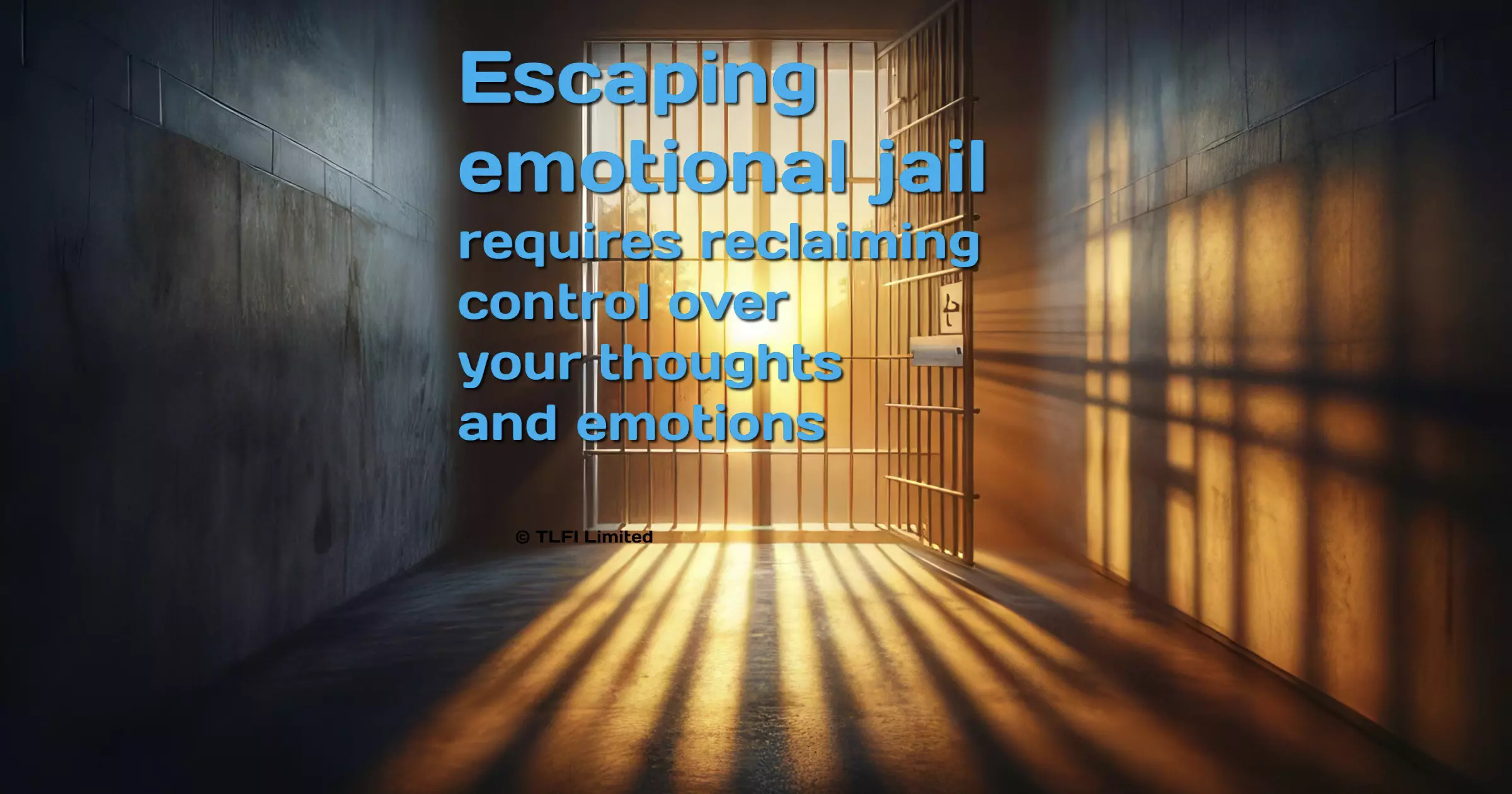
Escaping Emotional Jail

Emotional Jail is a powerful metaphor that encapsulates an entrapment which you may experience, due to the web of self-limiting thoughts and emotions manifesting when you get into a so-called emotional state. When you get deeply emotional, it becomes hard to recognise the barriers built by the passive intellect of the mind. In the throes of an emotional state, the passive intellect orchestrates a relentless parade of self-limiting thoughts and corresponding emotions, constructing an intricate tapestry of limitations and excuses. These thought patterns become the bars of your emotional jail, restricting your ability to think clearly. This metaphorical emotional prison is not only a construct of your mind, but also an energetic state that takes its toll on your mental, physical, and emotional well-being.

Escaping your emotional jail is about how you can learn transformative techniques to break the chain of emotional cause and effect. Thereby giving you an opportunity to break free from this emotional quagmire of your own construction.

The journey to escape the emotional jail is an inner odyssey, requiring commitment to mindful awareness and bringing forward cognitive mastery. As you cultivate these skills, they can help you to become aware of the thoughts and emotions which have formed the prison bars and walls. Being aware is the first step to being able to dismantle the walls of self-imposed limitations, creating an opening for renewed mental and emotional freedom. Escaping your emotional jail, requires reclaiming control over your thoughts and emotions, unlocking the potential for a more liberated, empowered, and balanced existence.

Entering into a state of cognition is an extremely useful key to unlocking your emotional jail. This is not a passive quietening of your mind, but a deliberate and focused effort to silence the cacophony of the thoughts. Cognition involves a dedicated purpose of thought, a specific conscious redirection of mental energy toward constructive, empowering, and liberating perspectives. By quietening the mind with intention, you can create a space for clarity, and the dissolution of the emotional jail’s energetic grip.